Links
A new gene regulating flavonoid synthesis has been discovered
Recently, the Tobacco Functional Ingredient and Biosynthesis Innovation Team of the Tobacco Research Institute of the Chinese Academy of Agricultural Sciences, in conjunction with the East China Agri-Tech Center, identified key genes regulating flavonoid synthesis from Chinese wild rice, elucidating their mechanism of action in the biological enhancement of flavonoids in rice seeds. The relevant research results were published in Plant Physiology and Biochemistry.
As a closely related species of rice, Chinese wild rice retains many excellent traits lost in cultivated rice. Compared with common colorless rice, Chinese wild rice has more abundant flavonoid compounds such as anthocyanins and flavonoid glycosides. However, there is still limited research on the exploration and utilization of genes regulating flavonoid synthesis.
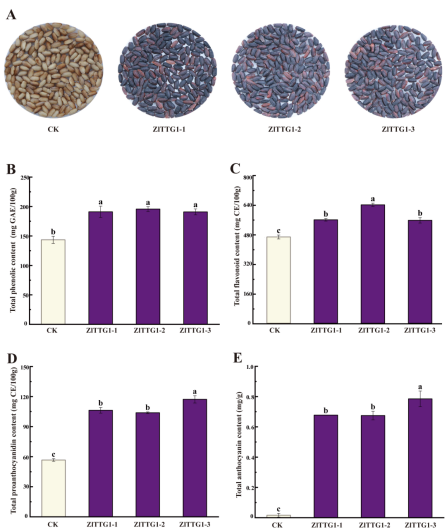
This study identified a key gene regulating flavonoid synthesis in Chinese wild rice through genomic collinearity analysis. This gene encodes a protein located in the nucleus, which can significantly increase the flavonoid content, antioxidant activity, and enzyme inhibition in rice seeds. Further research has shown that this gene can activate the expression of flavonoid synthesis structural genes, thereby achieving flavonoid accumulation in rice seeds. This study is of great significance for breeding functional rice varieties, ensuring national food security, and maintaining people’s nutritional health.
This study was supported by projects such as the Agricultural Science and Technology Innovation Program (ASTIP-TRIC05-2026) and the Natural Science Foundation of Shandong Province (ZR2023MC034).
Article Link:https://doi.org/10.1016/j.plaphy.2026.111392
By Yan Ning (yanning@caas.cn)