Links
Peptide Ratios Enable Tailored Morphologies of Amyloid Fibrils
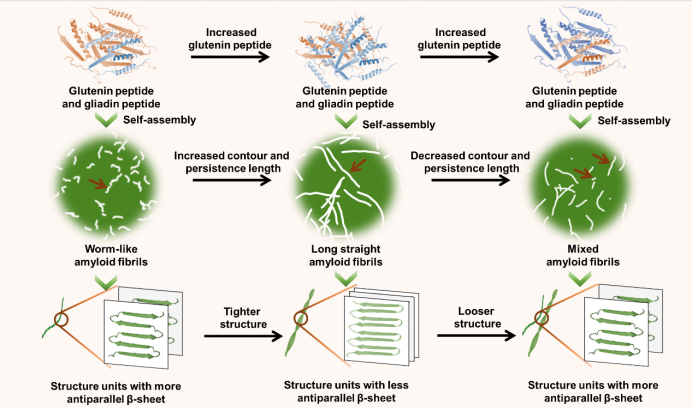
Recently, the Tobacco Smart Agriculture Innovation Team of the Tobacco Research Institute of the Chinese Academy of Agricultural Sciences, in collaboration with Beijing Technology and Business University, systematically elucidated the regulatory patterns and molecular mechanisms by which different peptide compositions mediate the co-assembly of glutenin and gliadin peptides into polymorphic amyloid fibrils. The findings have been published in Food Chemistry.
Amyloid fibrils are highly ordered protein self-assemblies with potential as carrier materials for nicotine loading and controlled release, offering promising applications in the tobacco field. The two major components of gluten protein (glutenin and gliadin) play distinct roles during fibrillation. However, how their peptide ratio affects the resulting fibril structure and morphology had not been systematically investigated.
The study found that at a glutenin to gliadin peptide ratio of 3:2, the long, straight, and rigid mature fibrils with the most compact molecular structure were formed. In contrast, excessive or insufficient proportions of either single peptide tended to produce short, curved, and flexible worm like fibrils. Correlation analysis further revealed that fibril morphology was closely associated with molecular structural compactness, which was regulated by hydrogen bonding, hydrophobic interactions, and electrostatic interactions. These findings not only provide a theoretical reference for customizing protein fibril morphology but also lay the groundwork for developing specialized protein carriers for nicotine loading and controlled release, thereby facilitating the research and development of next-generation smokeless tobacco products such as oral nicotine pouches.
This work was supported by the National Natural Science Foundation of China, the Agricultural Science and Technology Innovation Program, and the Tobacco Research Institute "Young Navigator" Program, among other funding sources.
Linkage: https://doi.org/10.1016/j.foodchem.2026.150224
By Feng Yulin (fengyulin@caas.cn)