
Links
A New Mechanism of Long-Term Manure Application in Reshaping the Soil Organic Carbon Pool in Tobacco-Planting Soils
Recently, the Smart Agriculture Innovation Team at the Tobacco Research Institute of CAAS, in collaboration with Qingdao Agricultural University, has elucidated a novel mechanism by which long-term manure application reshapes the soil organic carbon (SOC) pool in tobacco-planting soils. This finding provides a scientific basis and identifies key microbial targets for the precise management of soil carbon pools and the maintenance of sustainable productivity in tobacco-planting soils through organic amendments. The related research findings were published in Applied Soil Ecology, a leading journal in the field of soil ecology.
Soil organic carbon (SOC) and dissolved organic matter (DOM) are important soil constituents that significantly influence soil physicochemical properties, crop yield, environmental protection, and global climate change. However, long-term continuous cropping of flue-cured tobacco results in more severe losses of SOC and DOM compared with other crops.
Based on an 11-year long-term field experiment on tobacco-planting soils at the National Agricultural Science Jimo Observation and Experiment Station, this study first reveals the targeted regulatory effect of manure application on the molecular composition of soil carbon in tobacco-planting soils: the SOC content increased by 36.7%-40.7%, the abundance of alkyl carbon rose, whereas the abundances of aromatic carbon and di-O-alkyl carbon declined; The abundances of lipids, carbohydrates and condensed aromatic compounds in DOM increased, while the abundances of proteins and tannin compounds decreased. Secondly, the study elucidates the microbial driving mechanism by which manure application induces changes in the chemical composition of SOC and DOM in tobacco-planting soils: Bacillus and Chaetomium were significantly and strongly correlated with the accumulation of alkyl carbon and the degradation of aromatic carbon in SOC, as well as the enrichment of condensed aromatic compounds and the reduction of tannin compounds in DOM. Finally, the study found that manure application can reshape soil microbial interaction networks, thereby optimizing the molecular composition of SOC and DOM and enhancing soil carbon sequestration capacity, while concurrently improving soil microecological health. This research provides new insights for the ecological regulation of continuous cropping obstacles in tobacco.
Associate Researcher Zheng Xuebo and Master’s student Chen Xuelai from the Tobacco Research Institute are the co-first authors of the paper, while Associate Researcher Song Wenjing, Researcher Dong Jianxin from the Tobacco Research Institute, and Associate Professor Li Zengqiang from Qingdao Agricultural University are the co-corresponding authors. This research was supported by projects including the Science and Technology Innovation Program of the CAAS.
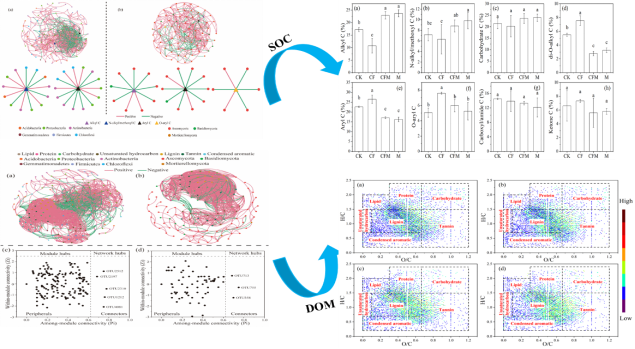
Article link:https://doi.org/10.1016/j.apsoil.2026.107092
By Zheng Xuebo (zhengxuebo@caas.cn)