Links
“Handheld Chip” Enables Rapid Detection of Biological Signals
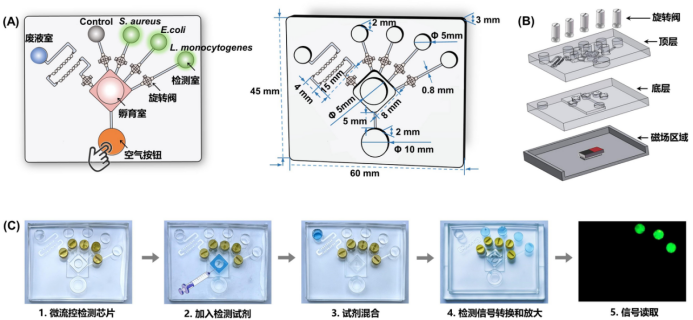
Recently, Tobacco Research Institute of Chinese Academy of Agricultural Sciences developed a novel finger-driven microfluidic chip for rapid bacteria detection. The chip achieved sensitive, visualized, and multiplexed detection of low-concentration biological signals. The study was published in Chemical Engineering Journal.
Pathogenic bacteria are key agents responsible for a wide range of plant diseases. Conventional detection methods rely on large-scale analytical instruments and well-equipped laboratories, involving complex procedures, high operational requirements, and long processing times. These limitations make it difficult to achieve rapid field-based screening. Moreover, the low abundance of bacteria in real samples, combined with interference from impurities and complex sample matrices, further reduces detection accuracy and sensitivity, posing significant challenges for practical applications in agricultural disease monitoring.
To address these problems, the research team developed a portable finger-driven microfluidic chip that does not require any external power source. By applying gentle press on the chip, fluid can be driven through the microchannels, enabling automatic sample transport and sequential completion of multiple reaction steps. The entire detection process, from sample introduction to signal output, can thus be integrated into a compact, easy-to-operate platform suitable for on-site applications.
The chip incorporates a specially engineered nano-recognition interface that functions with high specificity toward target bacteria. Acting like a “biological radar,” this interface enables efficient capture of pathogenic bacteria even at extremely low concentrations. Once the target bacteria are recognized, the system rapidly initiates a signal amplification process, generating clear and easily distinguishable fluorescent outputs. This allows for rapid, visual readout without the need for complex instrumentation, significantly improving detection efficiency and field usability.
This work was supported by the Science and Technology Innovation Project of Chinese Academy of Agricultural Sciences.
Original article: DOI: 10.1016/j.cej.2026.176803
By Wang Yingwen (wangyingwen@caas.cn)